Trump Screwed This Election Up In Ways He Never Even Saw Coming
November 4, 2026
Once again, Donald Trump ended up being his own worst enemy.
For months, the president swore the midterm elections would be corrupt, spending nearly 70% of his second term decrying election integrity or suggesting mail-in voting is unsafe. Trump tasked the Justice Department with prosecuting voter fraud rather than focusing on voting rights compliance. He sued states dozens of times over their voter rolls, insisting they would reveal a widespread conspiracy of voter fraud perpetrated by noncitizens. (The courts rejected him at every turn.)
At Trump’s direction, the DOJ deployed over 1,000 election monitors to all 50 states to look for fraud despite evidence showing it is exceedingly rare, prompting voting rights groups and state officials to warn monitors could be a thinly veiled pretext to intimidate voters and unconstitutionally wrestle control of elections from the states.
And the Department of Homeland Security, DOJ and FBI spent months broadcasting confusing and at times conflicting messages about whether ICE officers or other armed federal agents would be at the polls. An October University of California San Diego poll found that 40% of Americans fully expected ICE to be at the polls or interfere with elections. On Election Day, ICE sent out ominous warnings declaring, “If you vote illegally, we will find you. We will track you down, arrest you, and prosecute you. There will be no escape.”
Yet the Trump administration’s months of fearmongering failed to paralyze the nation on Election Day. There were a few issues: Some poll workers and voters at sites across the U.S., for example, reported being questioned by election monitors, including those from the DOJ. (Kiersten Pels, a DOJ spokesperson, told HuffPost that all department monitors followed state and local rules and had the same goal: “to observe for potential violations of federal law and report concerns to the Department, which the Department will review after Election Day and act where appropriate.”)
But overall, voters were mobilized and states were vigilant. Despite the president’s prophesying, things went pretty smoothly.
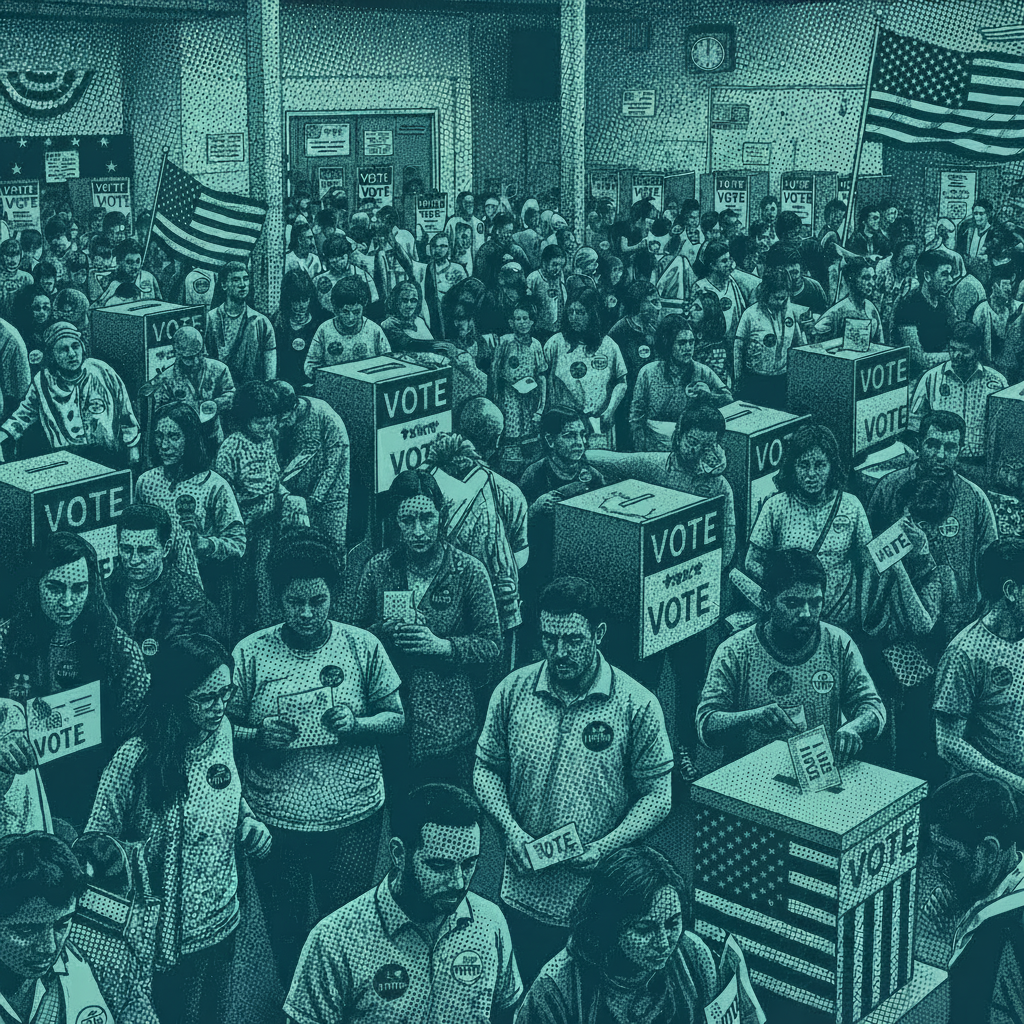
Some 60 million people voted early in this year’s midterms, and tens of millions turned out to vote in person on Tuesday. Young voters devoted to the Republican Party of 2024 swung away from the GOP, while Black voters turned out for Democrats in force. NBC exit polling suggested that Latino voters rejected Trump by margins so large that there was no way for him to effectively dispute the results.
While Trump regularly denies election results that don’t go his way, he has been much quieter this time. On Tuesday night, as the bloodbath became clear, Trump said he would accept the results of the election and work with Democrats. At his first post-election appearance, he waxed on about his ballroom construction, as if his party’s brutal defeat had never happened.
Any attempt to accuse such definitive results of being fake would have been pointless: Democrats’ historic defeat of the GOP on Tuesday night was not just a repudiation of the administration’s policies, but also a rejection of the warfare Trump inflicts on the public psyche.
Trump has wielded fear and misinformation as political tools since he first floated down an escalator and into America’s political consciousness. He told journalist Bob Woodward in 2016 that he considers fear more useful than respect. Bullying and pressure campaigns have come to define him and both of his presidencies.
“The reality is authoritarian leaders can only thrive in an environment of fear. If people do not fear you, you have no power. This fear is what this administration has traded on since the moment they stepped back into the office,” Mary Corcoran, co-founder and executive director of the citizen-led anti-Trump group Save America Movement, told HuffPost.
The group launched a program ahead of the midterms known as Vote Safe, working with voters in vulnerable districts to make sure they understood what was going on with ICE raids, arrests and detentions, and that they would feel safe at the polls.
Such collaboration takes away some of Trump’s power, Corcoran said.
“When people band together, they are not going to be afraid. When you can flip fear to defiance, it disenables authoritarian rule,” she said. “Person after person had been telling our teams that nothing was going to keep them from voting. People know what this administration was trying to do and they refused to be scared out of their democracy.”
odd Cox, associate director of the racial equality advocacy group Legal Defense Fund, told reporters on a press call Tuesday that he believed “the goal” of the administration’s scare tactics was to silence voters and keep people away from the polls.
But the Supreme Court gutting the Voting Rights Act with its decision in Louisiana v. Callais earlier this year had the opposite effect.
“Black people spoke out and said we will not be quiet while you try to steal our political power,” Cox said. (Indeed, Black voter turnout in Georgia was phenomenal, with some 2.8 million ballots cast in the early voting period alone, and ultimately broke 2022 midterm records.)
The administration’s threats targeting Latin and Hispanic communities also appeared to have the inverse effect.
Erica Bernal-Martinez, CEO of the National Association of Latino Elected Officials, told reporters on a press call Tuesday that 1.8 million Latinos voted early in Texas this year, which was an 87% increase from 2022. In North Carolina, 60,000 Latinos voted early, and Bernal-Martinez said this was triple the amount from 2022.
“Young Latinos are leading the surge on issues from cost of living to concerns over ICE,” she said. “Gaining control of Congress is motivating them.”