Cackling at Fascism: How Washington Learned to Laugh Last
September 17, 2026
Twenty-five years ago last Friday, irony collapsed sometime between 9:59 and 10:28 a.m.
Bare-knuckled spectacle hijacked the attention of our Queensberry Law-espousing country and, along with it, our guileless ability to laugh. From Stephen Thompson of the Onion to Tony Fox of Comedy Central and Roger Rosenblatt of Time magazine, even the cultural-intellectual elite agreed: The impending consequence of undercutting reality is, eventually, the joke is on you.
Now, a quarter of a century after Rosenblatt’s infamous eulogy for irony, it’s our government abandoning Queensberry’s high-minded principle that one “must win by the rules.” Only it’s traded devastating theatrics for craven skulduggery, demanding instead that we pay no attention to the man behind the ballroom curtain.
Nevertheless, the broader populace can’t help but see that conspicuous paunch looming behind the custom damask. And that constant involuntary exposure to the petri dish of hypocrisy has given rise to a new breed of artists, and an equally primed audience, all eager to exhume irony—that long-buried comedic lens—to expose where the punch line truly lies.
At a time when reality insists on becoming its own grotesque parody, we’ve been offered a useful escape from the absurd by those comedians, guerrilla sculptors, and professional rabble-rousers most deftly wielding it.
Ironic, dontcha think?
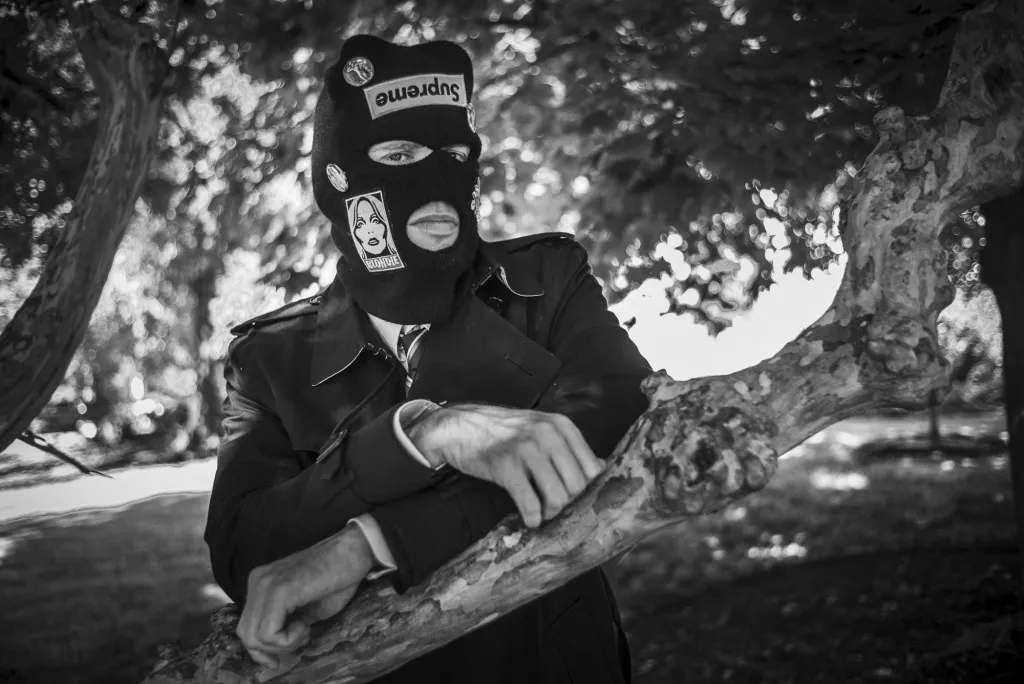
Because it can’t be mere coincidence that as cloaked agents roam the streets of D.C. and kleptocratic cronies govern from the shadows, it’s a masked avenger with a quick turn of phrase and a love for the McRib who’s got hypocrisy trending.
“I strongly believe that people don’t care about anything unless it’s entertaining,” John Jacobs, the man better known as ‘the Ski Mask Comedian,’ tells City Paper.
Throughout Trump 2.0, the 30-something DMV native has turned seats of power into open-air comedy clubs. Armed with a smartphone and a rotating cast of friends brave enough to hold it, Jacobs performs outside Union Station (“Stop and frisk this guy, he didn’t laugh hard enough”); 1600 Pennsylvania Ave. (“The closer you get to the White House, the more drugs are legal”); the Capitol Building (“I think the only statue that’s going to be left in D.C. is Mitch McConnell”); the Supreme Court (“The government is all about checks and balances; checks going into politicians’ balances”); and even the Israeli and Saudi Arabian embassies “because living is overrated.”
But why the mask? According to Jacobs, it’s pretty obvious.
“The only way you can fight absurdity is with more absurdity.”
To anyone fluent in acerbic wit, the madcap provocateur’s formative influences of Jon Stewart, George Carlin, and Greg Giraldo are obvious; however, it’s his love of Tom Green, Dana Carvey, and Pablo Francisco that reveals his more disarming comedic instinct—and the secret to his success: Everyone, even the objects of his ridicule, becomes a potential playmate in the sandbox of absurdity.
Though D.C. is notoriously impermeable (barricades and motorcades and clearances, oh my!) Jacobs has impressed a porousness that blurs both social and political hierarchy by putting pedestrians and policymakers on equally preposterous pedestals. Paradoxically, the black wool veil concealing his identity makes Jacobs even more relatable, as his microphone gives a rather witty voice to the silent majority.
“When I first [performed in the mask], I would say I was hired as part of an elite task force to relieve tension in America through political humor,” he says. While, sadly, no such coalition exists, Jacobs has made ample use of his own agency, regularly softening tough crowds—from MAGA tourists to food truck vendors—into unexpected patrons. Even the troops and Secret Service agents he lightly lampoons occasionally sneak a smile or stifle a chuckle.
To the stray heckler shouting banalities (e.g., “you suck”), Jacobs tells us he simply thinks to himself, “Wait a couple more jokes. I’ll probably hate the thing you hate, too.”
By cavorting with D.C.’s groundlings while playing its grandest civic stages, the former collegiate improviser turns the city itself into a scene partner, simultaneously demoting political archetypes back to their human scale. As a result, enemy can become audience, audience can become participant, participation can become protest, protest can become comedy, and comedy, without necessarily meaning to, can become protest.
“I never necessarily thought it was a form of protest,” says Jacobs. “But I guess technically a lot of art in general is a protest.”
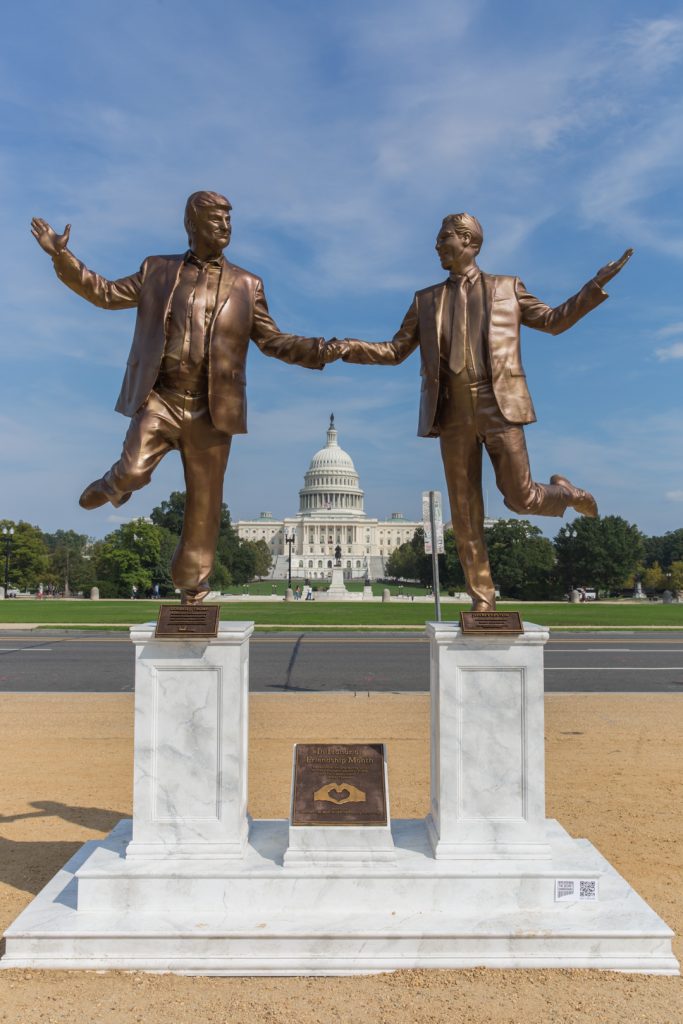
Like, say, the “Best Friends Forever” statue conspicuously placed across from the U.S. Capitol last September—a 12-foot erection of the 47th president frolicking with his alleged secret BFF, Jeffrey Epstein, their hands entwined in honor of Friendship Month.
Or the monolithic likeness of a tender birthday card from one admirer of the female form to another; or the clandestine besties later memorialized in a Titanic effigy of their forbidden love.
For what is art if not a garishly gilded latrine, seated near Abraham Lincoln’s stately marble temple, showing us not all thrones that glitter are gold? What is protest if not a retro arcade game allowing everyone to enter the mind of the 16-bit criminal that inspired Operation Epic Furious: Straight to Hell? What is irony if not an invading force, decked in their finest fatigues, playing that game instead of performing their assigned leaf-extraction duties?
Conspicuously placed across the District and reaching news and social feeds worldwide, these installations by the conversely discreet collective known only as Secret Handshake exhibit a perversely elegant brand of ridicule that has robbed our wannabe dictator of his desired emotional register.
And by raising landmarks to inconvenient historical facts while history is still arguing with itself, Secret Handshake is simultaneously performing one of journalism’s core civic functions: keeping consequential facts in public circulation. A story can’t be whitewashed if it’s already been bronzed.
Secret Handshake is also masterfully combating MAGA’s admitted “flood the zone with bullshit” approach to disinformation by consistently distilling the informational chaos into single, indelible icons.
Though City Paper briefly patched into Secret Handshake’s pirate frequency, we lost transmission before they could radio back with comment—unsurprising given their penchant for being seen not heard.
But the monumental team is giving people more than just something to look at. They’re giving those type A former student body presidents who preternaturally migrate to D.C. and loathe feeling powerless ways to get in on the joke. Visitors to Epstein’s hulking Hallmark keepsake could add their own heartfelt sentiments of poetic justice. Faux-proud citizens could contribute homemade trophies to Secret Handshake’s mammoth commemoration of the President’s now months-long “four-to-five-week affair” in Iran.
If Jacobs makes spectators into scene partners, Secret Handshake turns them into co-conspirators.
Like, have you heard the one about Sean Dunn, the Sandwich Guy?
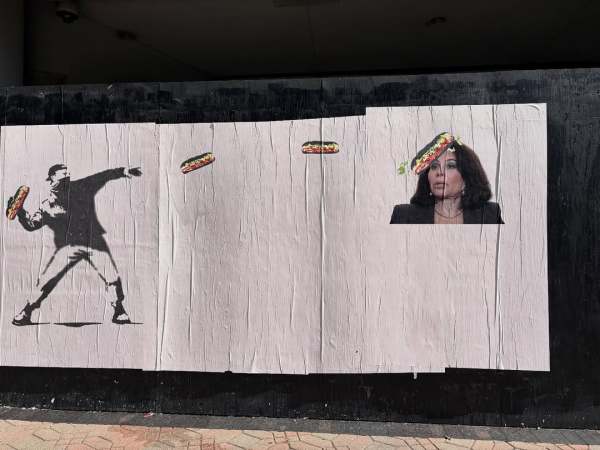
It goes something like this: An Air Force veteran just trying to eat fresh on a budget short-arms a foot-long straight into the ballistic vest of some federal goon. Doesn’t leave so much as a stain, yet in return, Dunn gets pummeled with a cold-cut combo of authoritarian bluster: Armed federal agents swarm his home, (former) Attorney General Pam Bondi announces he’s been canned, and Fox News host turned U.S. Attorney for D.C. Jeanine Pirro slaps him with a felony charge.
Only for the guy to get let off by a jury of his peers.
Twice.
Ba-Dunn ching.
But it gets better…
Mere days after the famously non-felonious foot-long collided with the Kevlar-ed bosom of injustice in August 2025, reproductions of Banksy’s Flower Thrower flooded the streets and feeds of Washingtonians; only this time it was a bun instead of a bouquet. And as Dunn’s legal proceedings unfolded layer by deli-paper layer, so too did the meaning of the image.
To a tourist, it’s a simple parody; they may even know the Bruno Barbey photo that originally inspired Banksy’s rebellious rotator cuff. But to the singularly well-informed populace of D.C., the “Sandwich Guy” print has evolved from yet another clever meme to a civic hieroglyph telling the tale of the hapless stooge and the residents who protected their own. It offers more than a reason to chuckle; it creates a reason to smirk. And behind a smirk is a momentary sense of satisfaction that can ignite a revolution.
Or so sayeth the experts.
Because, long before Jared Kushner’s father-in-law first deigned to return to the White House, creative Washingtonians have indeed been producing heaps of organic samizdat that would have made any Soviet Union dissident proud. But some professional heavy-hitters have also entered the circus, and they go by the name of the Save America Movement (or SAM).
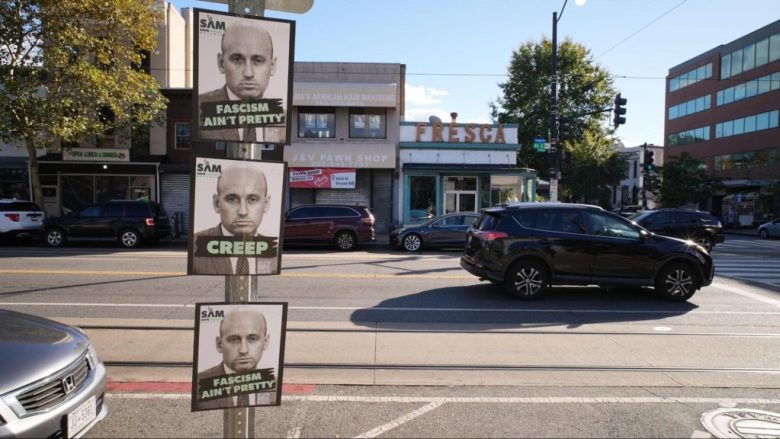
The Save America Movement originated weeks after the Tangerine Tornado blew back into the White House in January 2025. Concerned with the blowhard’s intensifying velocity, Mary Corcoran, formerly of the Democratic National Committee, enlisted the help of former Republican strategist Steve Schmidt—better known these days as the co-founder of the Lincoln Project. Schmidt’s political action committee, founded by “Never Trump” Republicans, was among the first to realize that laughing is more powerful than rage-posting.
“People turned to anger because anger felt appropriate for what was happening, but appropriate isn’t effective, and anger is exactly what Trump wants,” Corcoran tells City Paper. “Laughter really takes the wind out of any bully’s sails.”
Plus, it’s cost-effective.
The Save America Movement has proven time and time again that the next available dollar shouldn’t be spent on television ads, digital targeting, direct mail, or field work; it should be spent calling Stephen Miller ugly.
As Corcoran puts it, “Nobody screenshots a pre-roll ad. People do stop, look, and snap a poster of Stephen Miller that says, ‘Fascism ain’t pretty.’”
Better still, they write about it in the Atlantic and the BBC.
And it disrupts the fascists’ sleepmaxxing.
“Katie Miller was up late at night tweeting about the posters; we knew they were lying in bed talking about it,” recounts Corcoran. “That’s when we knew this worked. If it gets under their skin at midnight, it’s doing its job.”
While some could bemoan the 501(c)(4)-ification of the language of the people, SAM’s financial backing of the dilettante tactic validates its merits and offers hesitant civilians the professional impetus needed to step into the ring. SAM even makes all of its posters available online, effectively deputizing anyone with a printer into the District’s relentlessly productive wheat-pasting brigade.
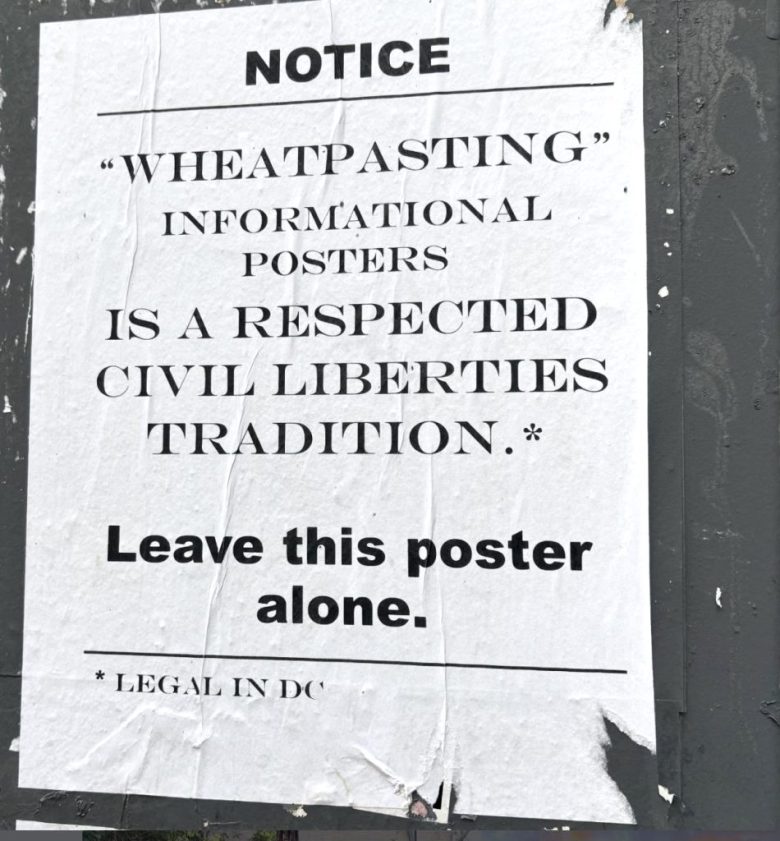
“Bravery is contagious,” Corcoran says. “Every time we do something on the ground, it emboldens somebody else, whether that’s one person, an organization, or a whole community, to stand up and push back. Our campaigns don’t just make noise. They give people permission to be loud.”
Legally loud.
Because Washington isn’t just fighting back with funny; it’s doing it clean. Jacobs asks permission before roasting government officials on government property. Secret Handshake exploits the same freedoms that afford the demagogue his pulpit. The Save America Movement plasters dissent where law permits—and, when one poster comes down, they paste another right back up. These aren’t concessions to the hallowed Queensberry decorum, but the weaponization of it.
Therein lies the final irony.
While the people in power busy themselves with ducking rules, testing boundaries, and searching for whatever gap in the ropes will accommodate the next indignity, D.C.’s merry band of revolutionaries has discovered the gaps above the belt.
Twenty-five years after irony was pronounced dead, those reports appear to have been greatly exaggerated. It is alive and well in Washington; wearing a ski mask, cast in bronze, wheat-pasted to a lamppost, and wrapped around a foot-long.
John Jacobs’ Halloween extravaganza, “The Astroworld of Politics,” starts at 2 p.m. on Oct. 31 on the Capitol Southeast Lawn. instagram.com. Free.
Don’t miss the rest of City Paper’s 2026 Fall Arts Guide, with nearly six dozen spotlighted events and features:
“D.C. Punk Returns to the National Mall for a Monumental Benefit Concert,” by Taylor Ruckle;
“Collaboration, Communication, and Critical Thinking: How Theater Education Goes Beyond the Stage,” by Melissa Lin Sturges
“Cackling at Fascism: How Washington Learned to Laugh Last,” by Bryce Taylor Rudow and Hil Horvath;
Correction: Mary Corcoran’s position with the DNC has been updated.